Scotland Seal World Cup Spot with Three Wild Goals as Potential Wales vs Ireland Play-Off Looms

Sunday evening was dominated by the exploits of Troy Parrott and the Irish national team, and Tuesday night held the potential for Scotland to bask in the limelight.
As this international pause began, each of the UK’s national teams still harbored hopes of reaching the World Cup.
England had already secured their place at the prestigious competition by topping their group last month, while Northern Ireland had locked in a position in Pot 4 of the play-offs, thanks to their achievements in the UEFA Nations League.
On Sunday, the Republic of Ireland followed Northern Ireland’s lead into the play-offs, triumphing over Portugal and Hungary in their concluding pair of group fixtures to guarantee a berth in Pot 3 of the play-offs as group runners-up.
Discover the full story of how this all transpired right here, delve deeper into the details.
The spotlight shifted to Scotland and Wales on Tuesday. Scotland faced Denmark in a crucial, winner-take-all match at Hampden Park, where only a victory would secure their automatic spot in the World Cup and allow Steve Clarke’s team to claim the top position in their group.
Trending
Denmark, on the other hand, simply needed a draw to clinch the group win and relegate their opponents to a lower seeding in the play-off draw.
For those not familiar with the intricacies of the revamped World Cup play-off format, you’re in good company. Here’s a breakdown:
A total of sixteen European national teams are distributed into four distinct groups. The top three groups are made up of the twelve teams that finished as runners-up in their World Cup qualifying groups.
The remaining four slots are allocated to teams that demonstrated strong performances in the UEFA Nations League competition.
FIFA’s official world rankings are used to determine the placement of each of the runners-up into the first three groups.
The top eight teams, according to these rankings, are designated as seeded teams, while the remaining teams are considered unseeded.
In March, the seeded teams would benefit from playing at home against unseeded teams in single-leg semi-final matches.
The matchups would be structured as follows: teams from the top group against teams from the bottom group, and teams from the second group against teams from the third group.
Following these semi-finals, the last four European teams to secure a place in the World Cup will be decided by four final matches.
The draw for the subsequent stage of the play-offs is scheduled to occur on Thursday, November 20th. Straightforward, wouldn’t you agree?
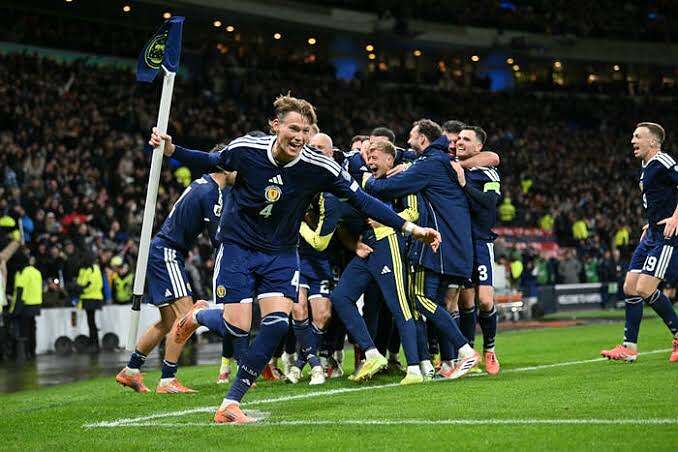
Naturally, Scotland were eager to bypass the complicated qualification process, creating a palpable buzz at Hampden Park; Denmark were overwhelmed right from the kickoff.
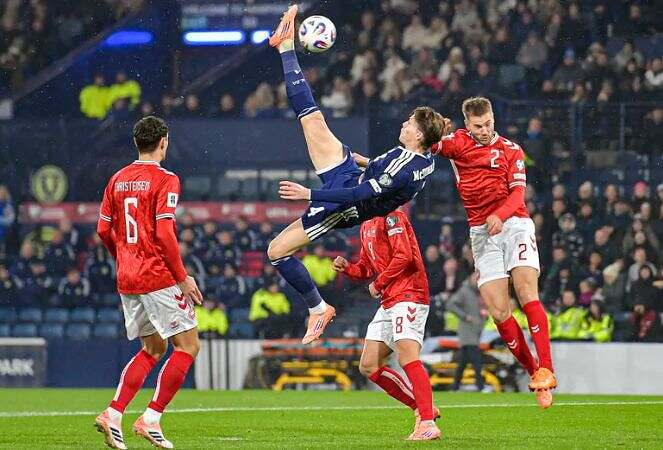
Scotland immediately took the initiative, pushing their rivals back, and Scott McTominay dramatically scored the opening goal within the first few minutes.
FC Bournemouth player Ben Gannon-Doak, who transferred from Liverpool during the summer, posed a significant threat early on for Scotland, troubling Manchester United’s Patrick Dorgu with his speed and attacking mindset.
Gannon-Doak set up McTominay for his goal, but the popular Napoli player was the key contributor, skillfully scoring into the bottom corner past Kasper Schmeichel with a bicycle kick – the game’s first attempt that forced the keeper into action.
Denmark exhibited impressive resilience, rebounding from an early deficit. Rasmus Hojlund, initially denied a goal due to a foul on Aaron Hickey, displayed determination with further attempts before eventually scoring.
Scotland suffered an early setback as Ben Doak was forced to leave the pitch after just 18 minutes, appearing to have strained his hamstring.
This incident noticeably deflated the Scottish side, allowing Denmark to apply sustained pressure. Nevertheless, the home team resolutely defended their valuable advantage until the interval.
Scotland’s lead was ultimately erased in the 57th minute, as Denmark rightfully levelled the score.
After an extended review by VAR, Andy Robertson of Liverpool was deemed to have committed a foul on Gustav Isaksen within the penalty box. Rasmus Hojlund calmly and accurately converted the resulting penalty kick.
Moments later, the match took another turn as former Leeds United player Rasmus Kristensen received a yellow card for a second bookable offense, offering Scotland a renewed sense of optimism.
However, despite this advantage, Scotland struggled to create opportunities, registering only a single shot, McTominay’s goal, by the 75th minute.
As Scotland’s optimism dwindled, they found motivation in Parrott’s dramatic late performance in their chaotic group stage conclusion.
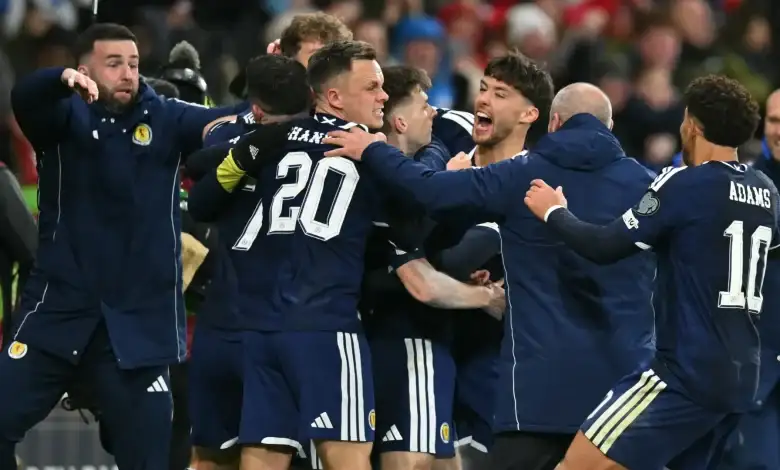
Lawrence Shankland’s goal from a corner kick by Lewis Ferguson reduced the deficit to 2-1, but Dorgu’s quick response threatened to crush their aspirations.
Instead, this spurred Scotland to intensify their efforts, dominating the closing stages and ultimately reaping the benefits.
During a lengthy period of added time, Kieran Tierney scored a stunning, arcing shot from beyond the box, bringing Scotland tantalizingly close to victory.
Then, in the dying moments, Kenny McLean sealed the triumph with an incredibly bold lob from midfield over Schmeichel.
It would be difficult to find a single game where a team scored three better goals, as Scotland secured their spot in the World Cup for the first time in over two decades in a heart-stopping yet unforgettable manner.
Wales had a faint possibility of topping their group and securing automatic qualification, but this depended on them winning their own game and relying on a highly improbable defeat for Belgium against Liechtenstein.
Belgium, predictably, won their match convincingly, thrashing Liechtenstein 7-0. Wales also recorded a resounding victory in their concluding group fixture, hitting seven goals.
Wales delivered an impressive display, securing the runner-up spot in their group with a dominant 7-1 triumph, highlighted by a hat-trick from Harry Wilson and further goals from David Broks, Brennan Johnson, Daniel James, and Nathan Broadhead.
Consequently, Wales will now contend with either the Republic of Ireland, Albania, Kosovo, or Bosnia-Herzegovina, who are drawn from Pot 3, in the playoff semi-finals scheduled for March.
Meanwhile, Ireland’s opponents will be one of Wales, Slovakia, Poland, or Czechia from Pot 2. From a neutral perspective, an all-home nations clash would be an exciting prospect.
Looking ahead to Northern Ireland, who are in Pot 4, they will face a formidable opponent from Pot 1, namely Italy, Turkey, Ukraine, or Denmark, in their semi-final match.