
Republic of Ireland Eyes Next Challenge After Parrott’s Heroics Ahead of Wales or Scotland World Cup Play-Offs

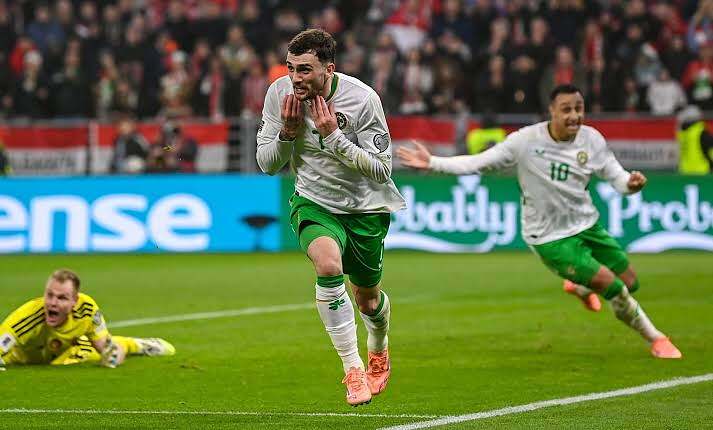
The Republic of Ireland’s unexpected qualification for the World Cup play-offs now faces a potential obstacle: a match against either Wales or Scotland.
This possibility looms as the play-off draw in March could pit them against one of their fellow home nations.
The Irish team’s recent surge in form has been nothing short of sensational. They secured their play-off berth in dramatic fashion, with a stunning victory over Portugal that left Cristiano Ronaldo visibly frustrated.
Following up this triumph, they achieved a hard-fought win against Hungary on Sunday, fueled by an incredible scoring streak from Troy Parrott, who bagged a remarkable five goals across the two pivotal games.
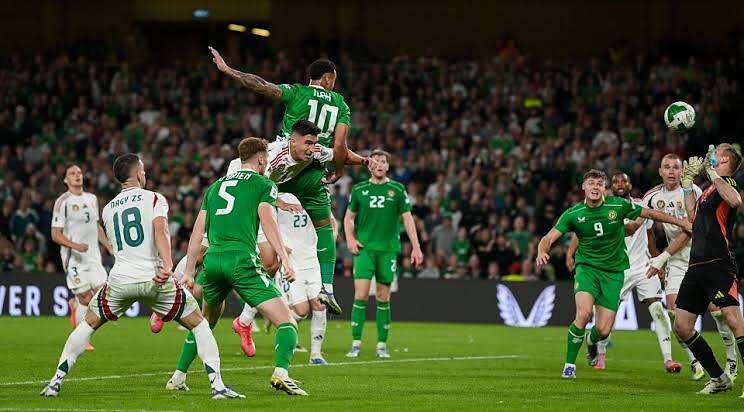
Their World Cup hopes were reignited by a surprising 2-0 triumph over Portugal at a vibrant Aviva Stadium.
Parrott’s goals in each half set the stage for a decisive encounter in Budapest against a formidable Hungarian side, featuring prominent Liverpool players Dominik Szoboszlai and Milos Kerkez, for the coveted play-off position in Group F.
Trending


Despite Hungary being favored, particularly on their home turf, Ireland displayed resilience and skill to overturn a 2-1 deficit late in the game.

The Irish team’s determination ultimately prevailed, with Parrott completing his hat-trick in the final moments, securing a crucial victory and a place in the play-offs.
After likely celebrations in Ireland last night, the focus now shifts to the upcoming World Cup play-offs. The road to qualification has become slightly more intricate due to the expansion of the tournament to 48 teams.
Within Europe, Ireland will be one of 16 nations participating in these play-offs, divided into four groups as they compete for the last four European berths in the World Cup.
These groups will consist of eight seeded teams and eight unseeded teams. One group will feature four teams who earned their place through their performance in the UEFA Nations League, while the other teams gained entry by finishing second in their World Cup qualifying groups.
FIFA’s official standings will be the deciding factor in determining the seeded teams. The complete list of participating teams will be finalized by the end of Tuesday’s games.
Currently, Ireland is positioned to be in one of the middle groups, although a better ranking and/or favorable results this week could see them move into the higher middle group.
Ireland would undoubtedly prefer to be in the higher middle group, as the seeded teams will have the benefit of hosting the single-leg semi-final match.
This includes the possibility of extra time and penalty shootouts against their unseeded opponents.
Therefore, the four teams in the higher middle group will be drawn to play a team from one of the middle groups at home in the semi-finals, while the top ranked teams will host a team from the lowest ranked group.
Notably, there will also be a separate draw to determine which of the winners from the semi-final round will have home field advantage in the four final matches.
At this stage, Ireland’s ranking and the lineup of teams they could face are still uncertain.
Currently, they’re in the third tier alongside Albania, who came in second in their qualifying group with England.
Kosovo’s position is also dependent on the outcome of their match against Switzerland; they’ll remain in Pot 3 unless they achieve a significant victory. Bosnia and Herzegovina are also expected to join this tier.
In the top tier, Italy is the only team whose place is secured. However, Turkey, Ukraine, and Poland are highly likely to also be placed in this prestigious group.
The second tier, or Pot 2, remains unconfirmed. The Czech Republic could potentially shift, while Wales, Scotland, and Slovakia are all projected to be included in this group based on the current standings.
The final tier, Pot 4, is anticipated to include Northern Ireland, Sweden, Romania, and North Macedonia.
So, at the moment, Northern Ireland could potentially face either Wales or Scotland in an away semi-final match, as these are just two of the four teams they might be up against.
However, it’s important to remember that this is by no means a certainty and things could change significantly.
Regarding Scotland’s chances, they can secure automatic qualification for the World Cup as group leaders if they manage to defeat Denmark in their upcoming game at Hampden Park on Tuesday.
Alternatively, if they end up in the play-offs, they’re almost certain to be placed in Pot 2, unless a highly improbable set of circumstances unfolds where four or more other results don’t go their way, which could then push them down to Pot 3.
Turning our attention to Wales, they are guaranteed to finish second in their group if they win their match against North Macedonia on Tuesday.
There’s a very slim chance of them finishing top – that would require them to win their game and for Belgium to lose to Liechtenstein, which is widely considered highly unlikely.
Finally, if Wales also find themselves in the play-offs, their seeding could fluctuate as well. They have a chance to be in Pot 1, but this would only occur if the outcomes of four other matches are favorable to them.
Therefore, to reiterate, should Wales or Scotland advance to the play-offs, they are highly probable candidates for Pot 2.
This sets the stage for an exciting potential semi-final showdown with the Republic of Ireland, potentially leading to a final match against one of the other competing nations we’ve discussed.
In essence, the scenario is quite straightforward. All the details will be solidified and become much more apparent following the play-off draw, which is scheduled to occur on Thursday, November 20th.